Sri Ramanujar
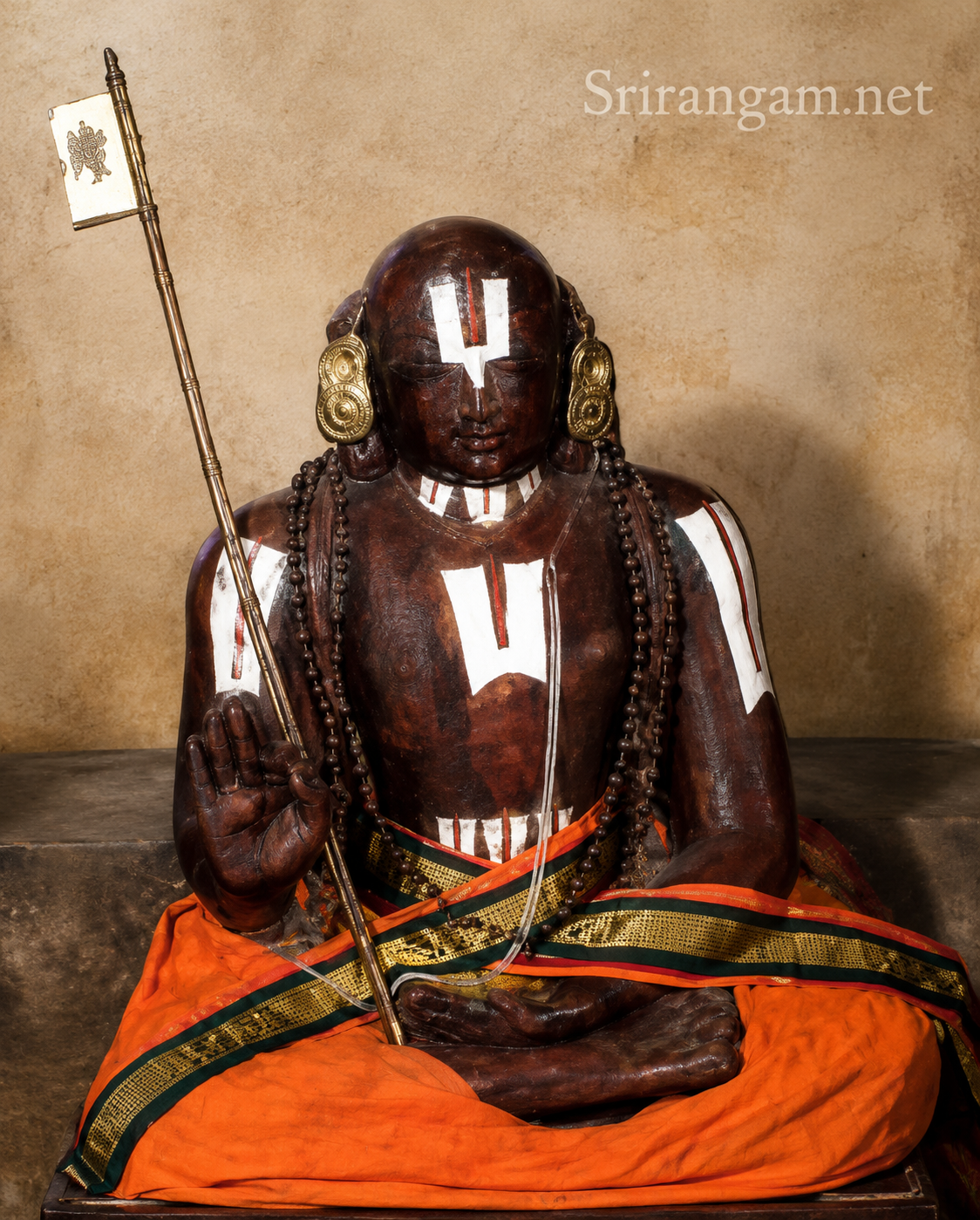
Sri Ramanuja incarnated at Sriperumbudur in 1017 CE, born to Kesava Somayajulu and Kanthimathi, on a Thursday in the asterism of Thiruvadirai in the month of Chithirai of the Pingala year, as a partial manifestation (amsam) of Adisesha.
In the Krita Yuga he served as Adisesha, the serpent-couch of Sri Ranganatha; in the Treta Yuga as Lakshmana, the younger brother of Sri Rama; in the Dvapara Yuga as Balarama, the elder brother of Krishna; and in the Kali Yuga he incarnated as Sri Ramanuja. To reform the world, to reveal the path of bhakti and sharanagati (surrender), and to lead humanity towards salvation, Sri Mannarayana in Paramapada summoned Adisesha and commanded him: "Live in the mortal world for 200 years and carry out the work described above." It was for this reason that he took birth as Ramanuja.
At Thiruvarangam, the Lord (Perumal), through Alavandhar's son Thiruvarangap Perumal Araiyar, arranged to bring Ramanuja, who was then in Kanchipuram, to Srirangam. Previously, five classes of temple servants carried out the koyil kainkaryam (temple service). They were the Kovanavar, Kodavar, Koduval Eduppar, Paduvaar and Thazhaiiduvaar. Ramanuja, during his time, expanded these five into ten groups. Following the Parameshwara Samhita of the Pancharatra Agama and the Thenkalai sampradaya, Ramanuja reorganised and refined the conduct of daily worship (thiruvaradhanam), sannidhi festivals and utsavams. In addition to the ten groups of Brahmin temple servants, he also appointed Vaishnava kainkaryaparas such as Ekangis and Sathatha Mudalis, and ensured the efficient administration of temple services.
The maximum lifespan of a human being has been reckoned at 123 years. Ramanuja lived for 120 years. In 1137 CE, at the time of his passing, he laid his head in the lap of his younger brother and disciple Embar, and placed his sacred feet in the lap of his disciple Andhranirnan, and thus departed this world to fill the seat that had long remained vacant beside the Lord in Paramapada.
Namperumal appeared in a dream and commanded that Ramanuja's mortal form (thirumeni) should be laid to rest in His own Vasantha Mandapam within the Akalangan Thiruchutru (enclosure). This was done accordingly. That place is today known as the Udaiyavar Sannidhi (Ramanuja's shrine). After Ramanuja's body was interred, a form manifested on its own — and that self-manifested form is the Moolavar (presiding deity) of the Ramanuja Sannidhi today. Ramanuja continues to watch over the administration he established, ensuring it is carried on without interruption.
This Moolavar of Ramanuja does not receive thirumanjanam (ceremonial ablution). Instead, a mixture of saffron (kungumappu) and green camphor (pachhai karpooram) is applied to the thirumeni twice a year — once in the month of Aippasi and once in Chithirai. In this manner, without any chemical preservative, through entirely natural means using saffron and green camphor, the sacred body is preserved from decay at this temple.
Ramanuja also served as the administrative reformer at Tirumala Tirupati, increasing the temple's endowments and performing many kainkaryams there. At present, in recognition of this service, the Srirangam temple's Jeer — the Sri Ranganaryana Jeer, who heads the Ramanuja Matham at Srirangam — has been accorded the Sri Sadari honour at Tirumala Tirupati annually since 2003. On that day, the Sri Sadari of Lord Tiruvengadamudaiyan is brought out to the Mugathuvaaram and the honour is formally conferred upon the Jeer, who then has darshan.
Furthermore, at the request of this temple's administration, the Tirumala Tirupati Devasthanam, acting under Andhra Pradesh Government Order No. 164 dated 7-11-2006, and as per the letter of the Commissioner of the Hindu Religious and Charitable Endowments Department, Chennai (No. 52664/2006 dated 08.09.2006), allotted 5,000 square feet of land at Tirumala Tirupati at an annual rent of Rs. 1,000 for a period of 30 years, on which a Jeer Matham with accommodation facilities has been constructed by the Joint Commissioner/Executive Officer.
Udaiyavar (Ramanuja) Sannidhi — Seva Timings:
Thiruvarangathamudanar, who composed the Ramanuja Nootrandhadhi, has his shrine at the south-western corner of the Chakkarathazhwar Sannidhi enclosure. The pillars here feature lion-motif carvings reminiscent of the Pallava period style. He composed the Ramanuja Nootrandhadhi, a work of 108 verses. This work is also known as Prapanna Gayatri. Just as the Gayatri mantra is to those who chant the Vedas, the Ramanuja Nootrandhadhi serves as the Gayatri for the Prapannas — those who have surrendered to Lord Thirumal, transcending all distinctions of caste. At this temple, the right to recite Iyarpa (Divya Prabandham in prose form) before Periya Perumal belonged to Amudanar, and he was also accorded the Brahmaratha honour for this privilege. The right to recite the Iyal seva during the Veda Vinnapam also belonged to Amudanar. Notably, Thiruvarangathamudanar has no vigraha prathishtai (installed idol) in any other Divyadesam apart from this temple at Thiruvarangam and Tirupati.