Sri Garudalwar Sannidhi
Location
The fourth prakaram (enclosure) of the Srirangam temple is known as the Thirumangai Mannan Thiruchutru or the Aalinadan Thiruchutru. Its walls were built by Thirumangai Azhwar. This enclosure houses some of the most significant structures in the entire complex: the vast Garuda Mandapam with over 200 pillars, the Paramapada Vaasal (Gateway to Heaven, opened only on Vaikunta Ekadasi), the Dhanvantri Sannidhi, and the Ramanuja Sannidhi.
Within the Garuda Mandapam stands one of the largest Garudalwar shrines among all 108 Divya Desams.
The Deity
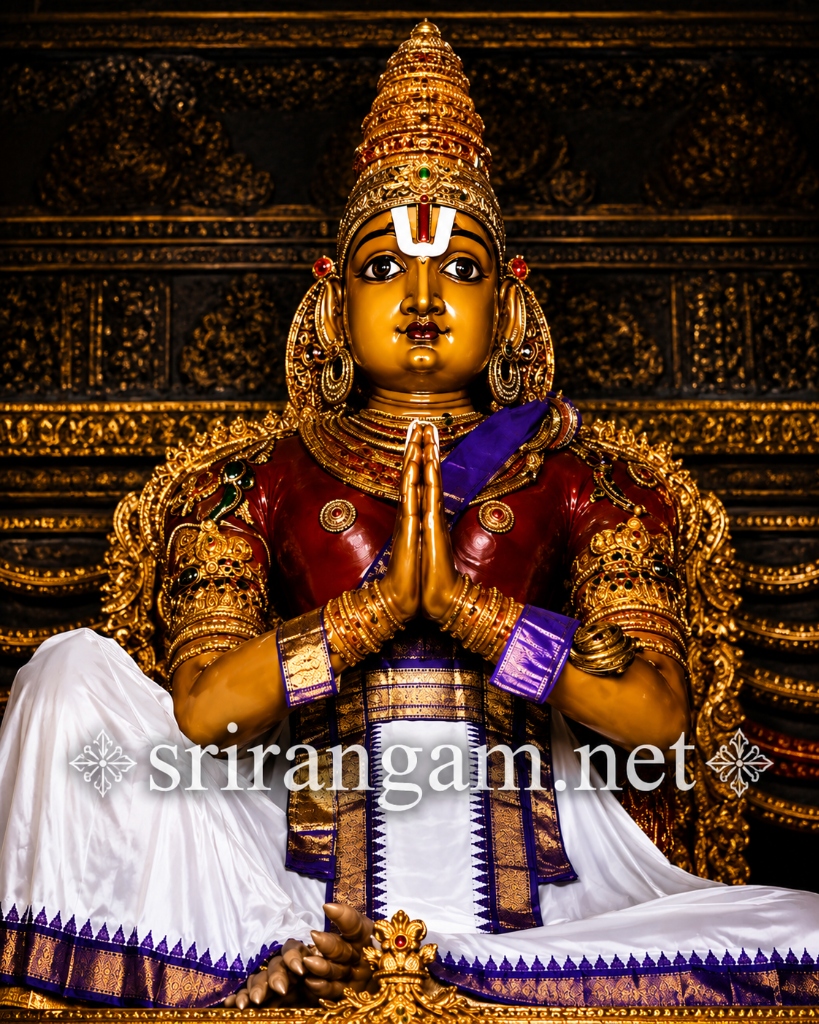
Garudalwar is enshrined here at a towering height of approximately 14 feet — a truly imposing presence. He sits directly opposite the Moolasthanam (main sanctum), in a seated posture with both hands joined in anjali (reverential salutation) facing the Lord.
He is adorned with the Ashta Nagabharanam — a jewelled ornament in the form of eight serpents. The hooded cobra that forms the base beneath him is carved with such lifelike intensity that it cannot fail to strike awe in the beholder. The image of Garuda seated upon serpents evokes the ancient Puranic relationship between Vishnu's mount and the Nagas — a tension between predator and prey that finds its resolution in the presence of the Lord.
The Legend — "Stay Right Here"
A beautiful sthala purana (local temple legend) explains why Garudalwar sits in this unusual posture.
Brahma once summoned Garuda and asked him to bring Lord Sri Ranganatha to this place and install him here. Garuda carried the Lord and set him down. Upon seeing Garuda, the Lord was pleased and commanded: "Stay right here."
From that day, Garudalwar has remained seated directly opposite the sanctum, waiting for the Lord's next command. It is said that he will continue to sit in this posture until Azhivemperuman (the Lord of Paramapada) issues a further order — an order that has never come. And so Garuda waits, in eternal devoted service, to this day.
This legend is offered as the explanation for Garudalwar's seated posture. In most other Divya Desams, Garuda appears standing, in flight, or kneeling. At Srirangam alone, he sits — not resting, but waiting. The distinction is theologically precise: his stillness is not repose but readiness, an unbroken act of obedience held across the centuries.
The Garuda Mandapam — Architectural Splendour
The Garuda Mandapam in which the Garudalwar sannidhi stands is one of the largest mandapams dedicated to Garuda among all 108 Divya Desams. With over 200 intricately carved pillars, it is widely regarded as one of the most beautiful halls in the entire Srirangam complex. The pillar carvings display fine sculptural workmanship and merit close examination by visitors.
Garuda in the Vaishnava Tradition
In the Sri Vaishnava sampradaya, Garuda is not merely Vishnu's mount — he is venerated as a divine devotee. The very name "Garudalwar" (with the honorific "Azhwar" meaning "one immersed in the divine") signals that he belongs to the same spiritual category as the great Azhwar saint-poets. He is Vishnu's nitya suri — an eternal attendant in Vaikuntha — who chose to serve as the Lord's vehicle out of love, not servitude.
At Srirangam, Garuda holds a special place of honour. When the Lord goes in procession, the Garuda Vahanam (Garuda mount) is among the most spectacular and eagerly awaited events, drawing large crowds of devotees. The image of Namperumal mounted upon Garuda, moving through the lamplit prakarams, is one of the defining sights of the temple's festival calendar.
Just as the temple elephant carrying Kaveri water at dawn evokes Gajendra Moksham (the liberation of the elephant-king by Vishnu), Garudalwar's eternal vigil opposite the sanctum represents the highest form of Vaishnava bhakti — patient, unwavering, and requiring no instruction beyond the Lord's single word.
Visitor Information
The Garudalwar sannidhi is accessible upon entering the fourth prakaram. The Garuda Mandapam is one of the finest architectural spaces in the temple, and visitors are encouraged to spend time examining the pillar carvings and the overall spatial composition of the hall. The 14-foot Garudalwar is visible from a considerable distance and serves as a natural landmark within the enclosure.