
Sri Dhavanthri Sannidhi
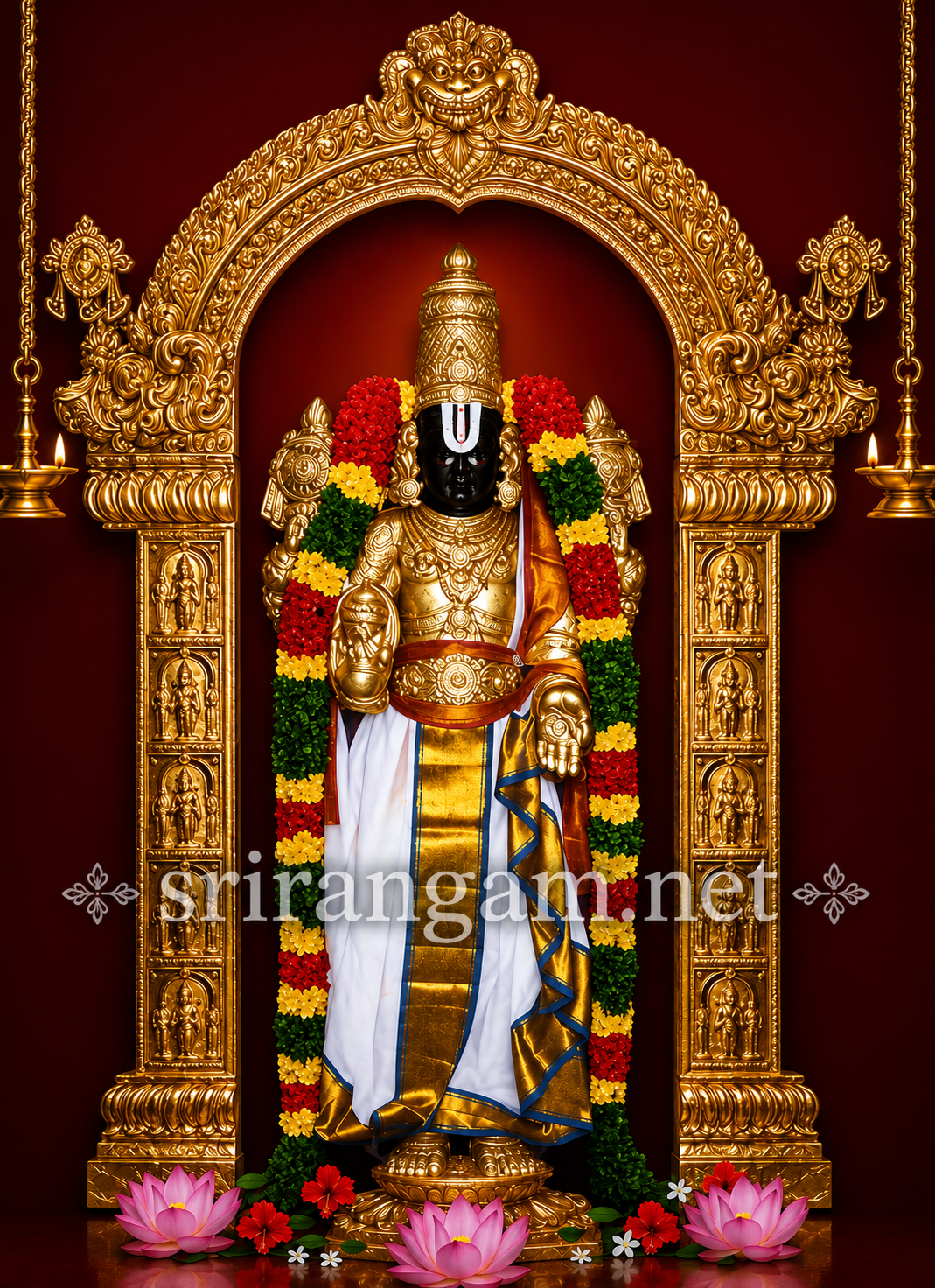
Among the many shrines in the vast complex of the Arulmigu Sri Ranganathaswamy Temple at Srirangam, the Dhanvantri Sannidhi holds a unique and profound significance. Dedicated to Lord Dhanvantri — the divine physician and the god of Ayurveda — this shrine is not merely a place of worship but a testament to ancient India's integration of spiritual faith and physical healing.
Who is Lord Dhanvantri?
According to Hindu theology, Dhanvantri is an avatar of Lord Vishnu, manifesting as the physician of the Devas (gods). His origin story is found in the Puranas, primarily during the grand cosmic event known as Samudra Manthan (the Churning of the Ocean of Milk).
When the Devas and Asuras churned the cosmic ocean using Mount Mandara as the churning rod and the serpent Vasuki as the rope, many divine treasures emerged. Among the last to appear was Lord Dhanvantri. He arose from the milky waves holding a kalasha (pot) filled with Amrita (the nectar of immortality) in one hand, and a leech (Jalauka) in another, along with the Sudarshana Chakra and the Shankha (conch).
The Mortal Incarnation
According to the Vishnu Purana, Dhanvantri incarnated on earth as the King of Kashi (Varanasi). Through his great-grandson Divodasa, Ayurvedic knowledge was transmitted to the world. The foundational texts of Ayurveda — the Charaka Samhita and the Sushruta Samhita — honour him as the primal teacher of the healing sciences.
The Shrine at Srirangam — Location
The fourth prakaram (enclosure) of the Srirangam temple is known as Mahar Lokam. Its walls were built by Thirumangai Azhwar. This enclosure also houses the enormous Garuda Mandapam with over 200 pillars — perhaps the most magnificent mandapam in the entire complex — and the Paramapada Vaasal (Gateway to Heaven) on its southern side, which opens only once a year on Vaikunta Ekadasi.
The Dhanvantri Sannidhi stands on an elevated platform on the western side of the Chandra Pushkarani (temple tank), facing east. It is one of only two shrines in the entire complex that are raised above ground level — the other being the Mettazhagiya Singar (Narasimha) shrine.
Temple tradition holds that on the path leading to the Thayar (Ranganayaki) shrine, Sriman Narayana himself appears as Dhanvantri to serve as the physician of Lord Ranganatha.
The Deity
The Moolavar (presiding deity) is a standing image (sthanaka thirukkolam) of Vishnu in his Dhanvantri form, approximately 5 feet in height, with four arms:
- Upper right hand — Chakra (Sudarshana discus)
- Upper left hand — Shankha (conch)
- Lower right hand — Amrita Kalasha (pot of nectar)
- Lower left hand — Varada Mudra (the gesture of bestowing boons)
Exceptional Features by Agama Standards
Two features make this shrine architecturally unique within the temple:
**No Utsavar.** Unlike virtually every other sannidhi in the complex, this shrine has no utsava bera — no processional deity. The Moolavar alone receives worship.
**No Vimana.** By Agama convention, every shrine in a temple should have a vimana (tower structure) above the sanctum. The Dhanvantri Sannidhi has none. The traditional explanation is characteristically practical: Dhanvantri is a physician; patients come to him. A vimana is therefore not required. This is one of the most distinctive Agamic exceptions in all of Srirangam.
Historical Evidence — The Inscription
The Hoysala-Era Foundation
In front of the shrine stands a stone slab bearing an inscription catalogued as ARE 80 of 1936-37 (Annual Report on Epigraphy). It dates from the third regnal year of the Hoysala king Pratapachakravartin Vira Ramanatha Deva (r. 1255–1295 CE) and records the following:
- **Patron:** Changadeva Singanna Dandanayaka, pradhani (chief minister) of the king
- **Custodian:** Garudavahana Pandita (Garudavahana Bhattar), the royal physician, designated as the rakshaka (protector) of the donor
- **What was founded:** A salai (hospital) to the west of the north gopuram in the fourth prakaram, with the enshrinement of the deity "Eduttakai-alagiya Nayinar"
- **Land endowment:** Agricultural land in Mummudisola Chaturvedimangalam, in Vilanadu, a subdivision of Pandikulasani Valanadu, was granted for the upkeep of the hospital
The inscription confirms that Garudavahana Bhattar — a practising Ayurvedic physician — established the Dhanvantri idol within the temple. This is not oral tradition; it is epigraphic record.
The Arogyashala — An Ancient Hospital
In earlier centuries, the Dhanvantri Sannidhi was not merely a place of worship. It functioned as the arogyashala — the hospital — for the residents of Srirangam. This is a significant detail for understanding the social role of South Indian temples: they were not only centres of worship and learning but also institutions of public health. The Dhanvantri shrine at Srirangam is physical evidence of this tradition.
Destruction and Rebuilding
The shrine was damaged during the devastating raids of Malik Kafur (1311 CE) and Ulugh Khan (1323 CE), during which much of the temple complex was plundered. It was subsequently rebuilt during the Nayak period. The painted ceilings and decorative elements visible today are attributed to the Nayak-era restoration.
Dhanvantri and Ranganatha — Special Rituals
The Kashayam — Divine Medical Service
One of the most charming traditions associated with this shrine dates from the time of Ramanuja (11th–12th century). Every day, before the aravanai — the final puja of the day when the Lord retires — a medicinal kashayam (herbal decoction) was sent from the Dhanvantri shrine to Lord Ranganatha.
The logic behind this practice is disarmingly simple: Ranganatha receives continuous offerings of very rich foods throughout the day — pongal, tamarind rice, sweet pongal, payasam, and many other preparations. To keep the Lord's system healthy after such a diet, Dhanvantri — as the resident physician — would dispatch a kashayam as his medical service to the Lord. A digestive made from ginger and jaggery was also sent to Ranganatha after certain meals.
This practice transforms an abstract theological concept — Dhanvantri as the physician of the gods — into a daily, tangible ritual within the temple's routine.
Herbal Theertham for Devotees
Visitors to the shrine receive a prasada theertham — a herbal decoction — as a sacred offering. This continues the ancient association between the shrine and healing, and distinguishes it from every other sannidhi in the complex, where the prasadam is invariably food or sanctified water.
Healing and Devotion
Devotees suffering from illness — particularly chronic or otherwise intractable ailments — come to this shrine to perform archana and thirumanjanam before Dhanvantri Perumal, praying for relief. It is a deeply held belief that worship here can cure bodily afflictions and restore health and vitality.
Dhanvantri Jayanti is celebrated annually on Dhanteras (Dhanvantri Trayodashi) — the thirteenth lunar day of Krishna Paksha in the month of Kartik, one day before Diwali. This day is also observed as National Ayurveda Day across India.
The Dhanvantri Mantra
Om Namo Bhagavate Maha Sudarshana Vasudevaya Dhanvantaraye
Amruta Kalasha Hastaya Sarva Bhaya Vinashaya
Sarva Roga Nivaranaya Trilokya Nathaya
Sri Maha Vishnu Svarupa Sri Dhanvantri Svarupa Namaha
*(We bow to the Lord known as Sudarshana Vasudeva Dhanvantri, who holds the pot of the nectar of immortality, who destroys all fears, who cures all diseases, who is the Lord of the three worlds, who is the very form of Sri Maha Vishnu — to that Dhanvantri, we offer our salutations.)*
The Dhanvantri Sannidhi at Srirangam is not a minor sub-shrine. Founded in the 13th century by a Hoysala royal physician, functioning as a hospital for the temple town, possessing an Agamic architecture that breaks convention (no vimana, no utsavar), and maintaining a living tradition of herbal theertham and the kashayam service to Ranganatha — it stands as an unmatched institution among the 108 Divya Desams. In a temple complex often celebrated for its scale, its festivals and its theology, this small, elevated, tower-less shrine is quiet proof that the sacred and the medical were once the same thing.
Sri Dhanvanthri Sannidhi – Thirumanjanam Information
The Sri Dhanvanthri Sannidhi is situated opposite the Paramapada Vasal (Paramapada Gate) in Alinadan Thiruchuttru, the Fourth Prakaram of the Sri Ranganathaswamy Temple, Srirangam.
Sri Dhanvanthri Perumal, the divine physician and incarnation of Lord Vishnu, is enshrined here in a majestic standing posture, holding the Shankha (Conch) and Chakra (Discus), with four sacred hands bestowing blessings upon devotees.
Devotees believe that sincere and regular worship at this sacred shrine, especially by those suffering from chronic or incurable ailments, invokes the divine grace of Sri Dhanvanthri and brings strength, healing, and well-being.
Thirumanjanam (Sacred Abhishekam): Days: Sunday, Monday, Tuesday, Wednesday, and Friday. Time: 11:00 AM – 12:00 Noon. Offering Fee: ₹1,200. Margazhi Notice: Thirumanjanam is not performed during the Tamil month of Margazhi.
Contact for Thirumanjanam Booking: For Thirumanjanam reservations and further information, please contact: Mr. S. T. Harikrishnan, Thirumanjanam In-charge, Mobile: +91 81224 85950.
Sources
- Stone inscription ARE 80 of 1936-37, fourth prakaram, Ranganathaswamy Temple, Srirangam
- Chitra Madhavan, Vishnu Temples of South India, Volume 2, 2008
- S. Krishnaswami Aiyangar, South India and Her Muhammadan Invaders
- Koyil Ozhugu (Temple Chronicle of Srirangam)
- Bhagavata Purana; Vishnu Purana; Vishnudharmottara
- Charaka Samhita; Sushruta Samhita